A Flock Of Seagulls: 3 Years Of Brilliance, 1982-84

Across their first three albums, A Flock Of Seagulls had a formula and a winning sound.
In this post, I’m going to try to argue that A Flock Of Seagulls were better than the last band I wrote about, Thompson Twins. Not that these two bands were rivals. They were just both on MTV, with Thompson Twins following Seagulls by about 2 years. Seagulls were smack in the middle of the New Wave explosion that gave us Yazoo and Duran Duran. They provided a video that MTV needed to add to its rotation, and it became a big hit (I Ran peaked at # 9 on the Billboard Hot 100).
A Flock Of Seagulls are still around. They visited New York in their recent summer 2025 tour, albeit with a different lineup behind founding lead singer, Mike Score. And that lineup came back to New York in December 2025. But to appreciate them, you just need to listen to their first 3 studio albums, made in quick succession between 1982 and 1984. They burned bright for 3 full calendar years, helped make synthpop a permanent fixture of pop music, and then they pretty much disappeared after their very creative guitarist, Paul Reynolds, left the band in 1985.
I argue that the first three albums from A Flock Of Seagulls are excellent, almost end to end. For me, the key to their success was Paul Reynolds’ riffs, their ‘wall of sound’ engineering in their recordings, and a constant, unchanging lineup. The lyrics are solid. The guitar riffs are bright and very memorable, and they complement Mike Score’s narrow vocal range. And the layering and mixing are some of the best in this brief, early 80s New Wave period that includes to rise of The Human League, Heaven 17, Thompson Twins, and Soft Cell. Most listeners and critics don’t like the dark turn A Flock Of Seagulls took after their brilliant debut, but I do. Furthermore, one only needs to sample a few tracks in the band’s last three albums (1986, 1995, 2024) to understand how the wheels fell off. Are there any good Seagulls songs after 1984? I suppose I should give the last three albums a full listen, but my guess is there isn’t anything as good from LP 3.
In the streaming era, listening to a band’s discography is cheap, and doesn’t require buying the records. So in just 2 hours and 5 minutes, you can stream all three of these albums. Add them to your streaming queue and let them rip.
And if you do that, listening to their first three albums in about the time it takes to listen to 2 or 3 big podcasts, you will be exposed to their signature sound and consistency. Hopefully these 3 albums, encompassing 30 tracks, will be to your sonic satisfaction.
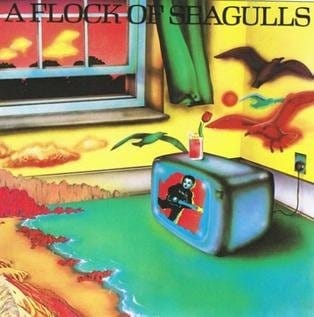
A Flock Of Seagulls, April 1982
Zomba/Jive records must have known they had a winner. First there was a single. Then an EP. Then a full album. This won a Grammy for Best Rock Instrumental (the track D.N.A.)! But three songs really stand out.
Songs from the first two Seagulls albums have a lot of momentum. Whether its the drum machine, the synths, or those guitar riffs, the sounds really propel the songs with a higher than average BPM compared to most other New Wave songs. Great for dancing or driving. Also noticeable right away is Mike Score’s favorite themes. He likes science fiction, a little futurism, and technology. And that all ties together here. We have astronomy telescopes, TV broadcasts, and lasers delivering digital data, all in one simple song. And while the delivery and speed is a little punk, this clearly post-punk / new wave. If I were to make a 1982 playlist, it starts with this song and ends with Yazoo’s Only You.
I Ran
Is Score running away from the girl at the end, or is he describing an alien abduction? In any case, this video is silly and genius. It’s an homage to the No Pussyfooting cover photo. I think I realized that when I bought a CD of No Pussyfooting in 1999, catching up with both Fripp and Eno’s discographies. I rate the long synthesizer intro very highly, similar to the extended baseline in Billie Jean. I think I Ran is the better song. It may be an 80s musical touchstone. That bright, delayed guitar and solo that Reynolds puts down is immediately recognizable by generations now. It is synonymous with the 1980s. In 1982, building legos on my bedroom floor on a typical Saturday morning, I heard this song regularly on US Top 40 pop radio, alongside the Go-Go’s, Yazoo, The Waitresses, Toni Basil, Berlin, Soft Cell, The Cars, Bow Wow Wow, and other new wave classics.
Back to technology. I took this song literally when I first heard it, thinking Score was signing about a satellite he saw in the sky. He says it’s about spotting a beautiful girl across the room at a party. In any case, this song has all the strongest elements of Seagulls. A strong, extended riff (almost a recurring solo), a catchy one line chorus, and a pleasant wall of sound production.
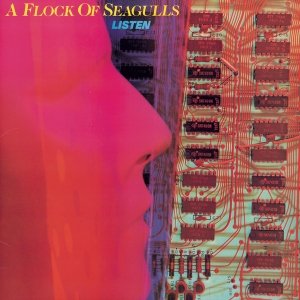
Listen, April 1983
This is how you do it. You put out an album almost exactly a year after the last one. It’s a better album, in my opinion. This is the Seagulls album I fully replay the most. The song sequence has flow, and the songs range from good to great. The band’s previous year was focused. It was mainly just touring and songwriting. Besides some partying, that was it. Critics detected a darker tone in the new songs. But as I remember it as a 10 year-old, the songs on Listen sounded like a continuation of the studio work on the debut. The band worked in Conny Plank’s studio outside Cologne. The production credits were again split between Mike Howlett and Bill Nelson.
It needs to be stressed that the band’s bassist, Frank Maudsley, really stepped up and contributed better basslines in the second and third albums. You can hear him a lot more, and their music got richer as a result. Same to the drum machine, or I should say, the Movement, which producer Mike Howlett was mastering. Yeah, the Seagulls had Score's brother on drums, but the drumming was split between human drummer and the Movement, by Movement Computer Systems, of course! Howlett used the Movement on tracky by OMD and Thompson Twins as well, and that's how Seagulls totally slot in with them geographically and musically.
Wishing (If I Had A Photograph Of You)
I Ran has a long synth intro. This darker tune -their third American top 40 hit- has a long synth outro! My favorite part is when that outro starts. I don’t think I ever liked the metallic drum machine. But once the synth warms up, its tones and drones suppress the drum machine and we get a seriously good ride. It isn’t quite the synth ride that Cars gives us, but this is rare in pop music. (Also see Waiting For A Heartbreak.)
Nightmares
Darker still. This song resonated with me as I had a year of nightmares. It was a recurring nightmare. I think I was 5. Wen I told my mom about them, they fortunately stopped. The video for Nightmares was directed and stars bassist Frank Maudsley.
This song absolutely soars with that extended guitar riff, backed by Mike Score's synths. That’s the core of this single. This is a breakup song that is simple enough. Score is mainly a monotone singer with limited range. But his wavering, fluctuating delivery in the pre-chorus wins me over. “If I see you WALK-KING. If I see you TALK-KING.” This is my case for LP 2 being just as good as LP 1. The evidence is here.
(It’s Not Me) Talking
Simple in structure and lyrics, this track aims to be a dance song. What’s significant about Talking is that it was their debut single in 1981. This version, recorded in 1983, is bolder and more polished. And again, it’s got speed and momentum.
This had to be considered as a single, and it was part of their tour setlist throughout 1983. It’s thrashy. Score’s keyboards and Reynold’s six string play off each other. I like this track more than Transfer Affection, actually, which was a single. The not-surprising theme is technology and electricity. Pair it with OMD’s Electricity, and think of David Lynch’s fascination with electrical power and various electrics.
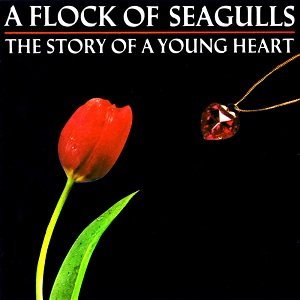
The Story Of A Young Heart, August 1984
This is their third album, and the last one worth listening to. This is a concept album, reflecting on heartbreak, loss, and even suicide. It yielded just one minor hit single, singling the end of the band’s commercial run. They also lost their lead guitarist, Paul Reynolds, as he had to leave to handle his heroin addition and take better care of himself.
The More You Live, The More You Love
I admit, the Seagulls were running out of juice by this point. But they had one last single in them with an almost cliche title. Or maybe the song launched the cliche. In any case, their signature sound was still intact. We have Robinson’s long guitar riffs and Score’s droning vocals carrying the song.
But get this, the heart of the album has three solid tracks in a row: Remember David, Over My Head, and Heart Of Steel. Some care went into this album and its song sequence. These 3 songs in particular are different from each other. We hear the band trying new things. There’s a mid 80s sound Over My Head, and a live-sounding, authentic New Wave composition in Heart Of Steel.
A galloping rock track with a simple synth solo in the middle. I don't like this track as much as the next two, but in the order of songs on the album, this track injects fresh energy to kick off the album's side two.
This track has more unison between guitar, bass and synths. I get hints of Gene Loves Jezebel in this one. It's a slightly new direction for the band, which makes all the tracks on side two so good.
The best song on side two. Here is a glimpse of the band putting some of their best strengths together, minus the synths. The synths and loud guitar riffs are put aside, while the bass and drum are brought to the front. This makes the song sound like a true post punk composition from the very early 80s. The bass line is better. The vocals are better, complete with delay effects and layering. The cymbals crash above the droning tones. And then they let it ride for a good minute, like a toned down version of I Ran. I could totally see this song being added to the GTA Vice City soundtrack. This is really good.
The final song is an odd one but I like it. Suicide Day depicts the singer telling their ex that they no longer have a reason to live since the breakup. It’s dramatic and a little scary. But it is also bops.
A Flock Of Seagulls totally belong in the study of peak New Wave artists from roughly 1978 to 1984, thanks to Paul Reynolds' creative, effects-heavy guitar riffs, the era-appropriate themes of technology and science fiction, and their first three beautifully engineered and mixed albums.
Give them 2 hours of your time today!